Zero Demos vs Imitation Learning
Same robot arm, same two tasks, same scoring as our 384-demo imitation-learning study. Can an LLM agent with generic robot tools and no training keep up?
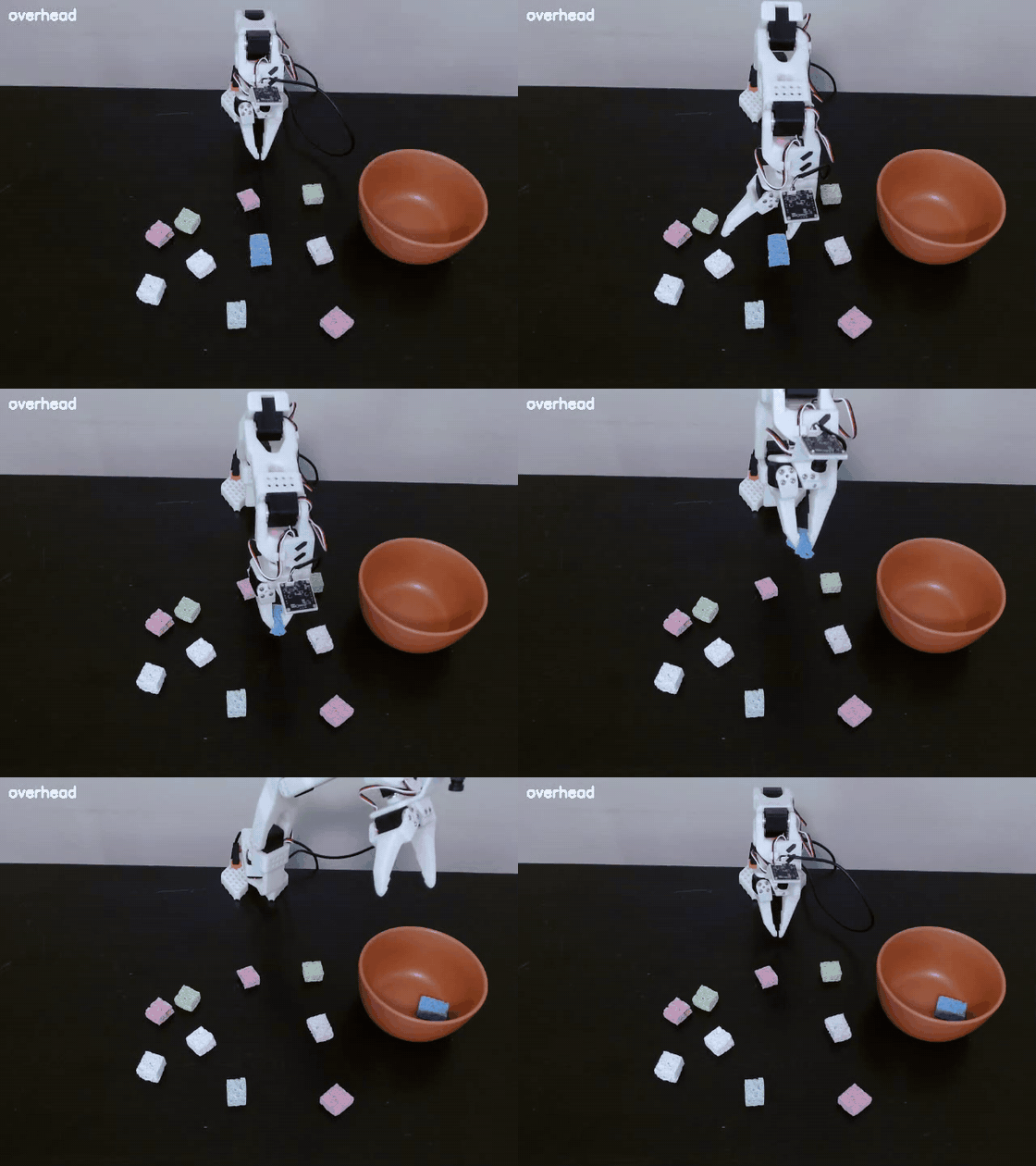 4× speedOpus 5.5 + MCP
Two Tasks, One Instruction
Both systems get the same text: “Pick the blue sponge or sponges and place them in the bowl”
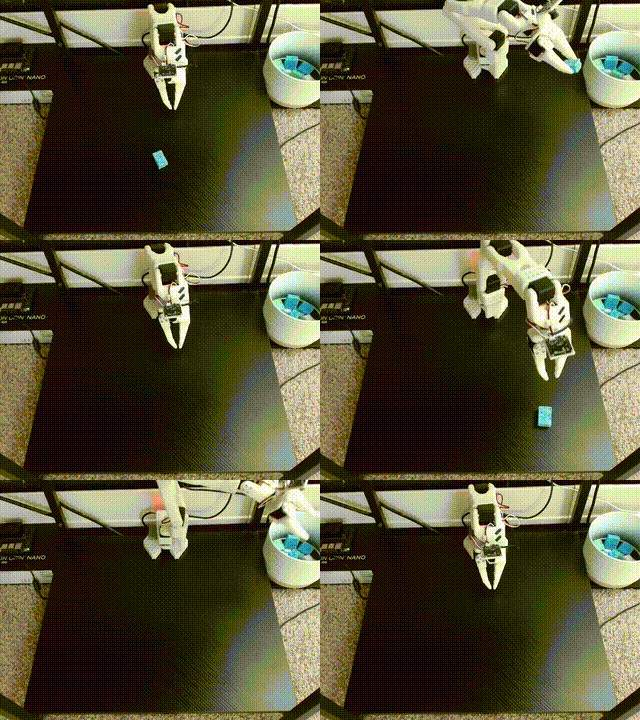
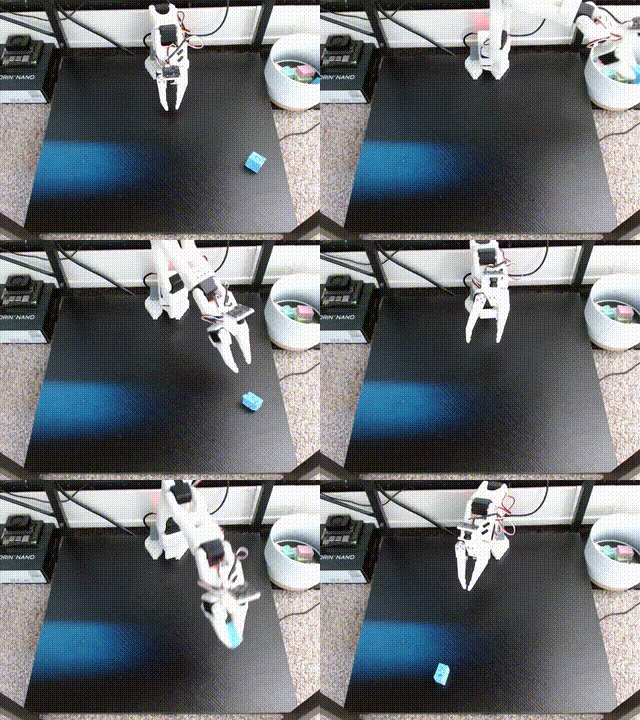
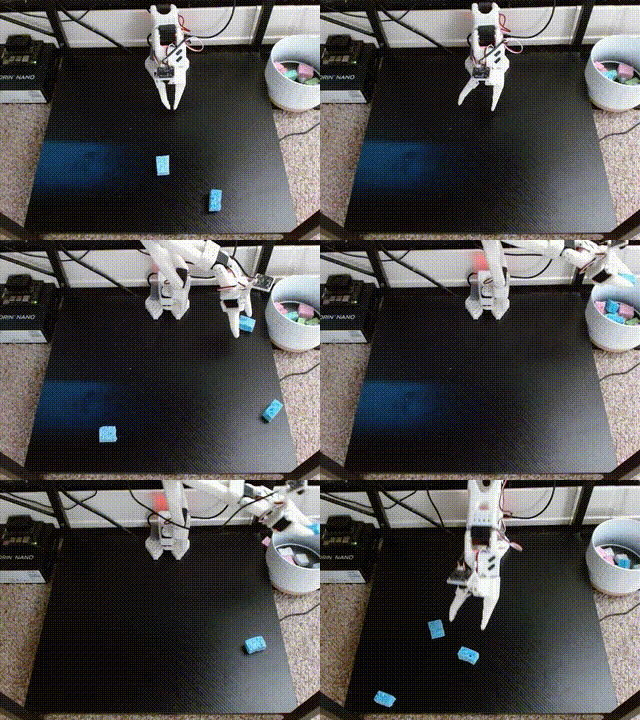
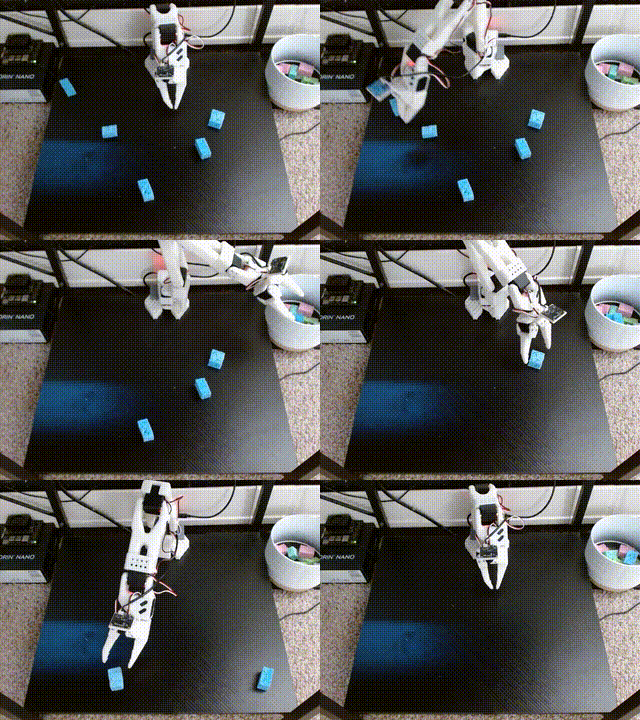
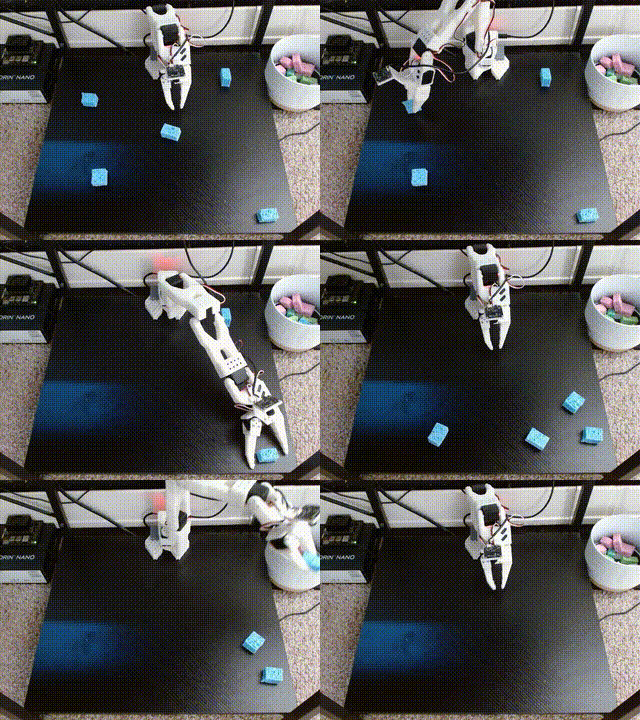
TASK 1demos: D2
Several blue sponges, clean table
Every blue sponge must end up in the bowl.
IL eval: 2 sponges · 16 trialsOpus: 1–6 sponges · 10 runs · 32 sponges
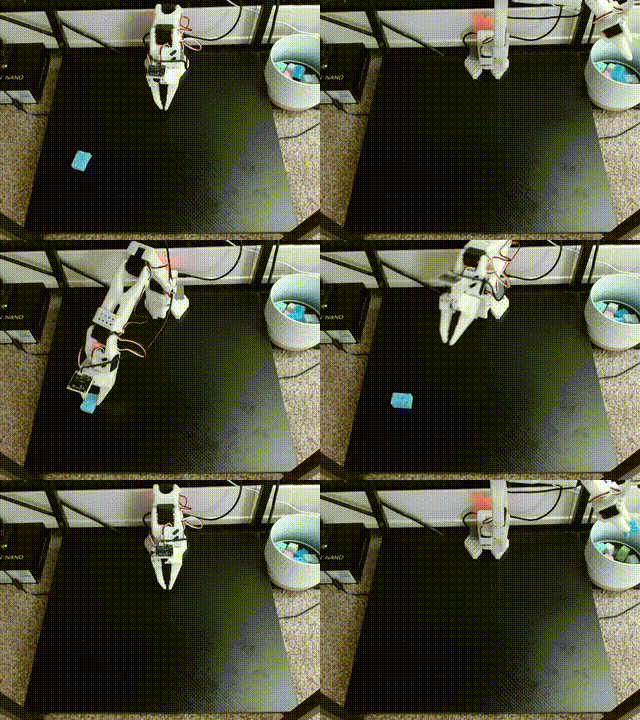
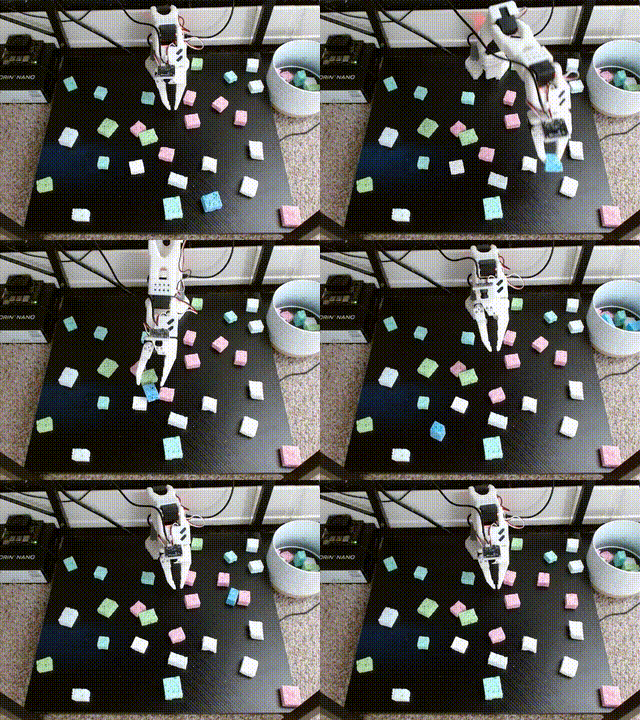
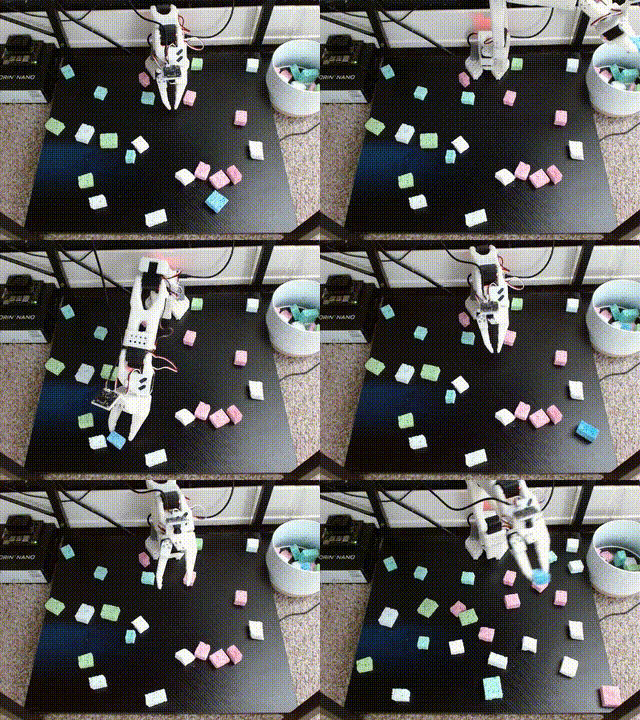
TASK 2demos: D3
One blue sponge among distractors
Only the blue sponge may go in the bowl. White, pink, green and aqua sponges stay out.
IL eval: 16 trialsOpus: 9–11 distractors · 10 runs
IL baseline · D_Universal
384 teleoperated demos: D1 + D2 + D3 Combined, 128 per task (one sponge, several sponges, distractors), 64 at marked and 64 at random positions. ACT, SmolVLA and Pi0.5 were each trained on all of it. Scored /20: 8 marked trials ×1.0 + 8 random ×1.5.
Opus 5.5 + MCP
Zero demos, no training. Every scene is a new random layout, so every success counts 1.5: 10 runs = 15, scaled to /20. A human checked every run.
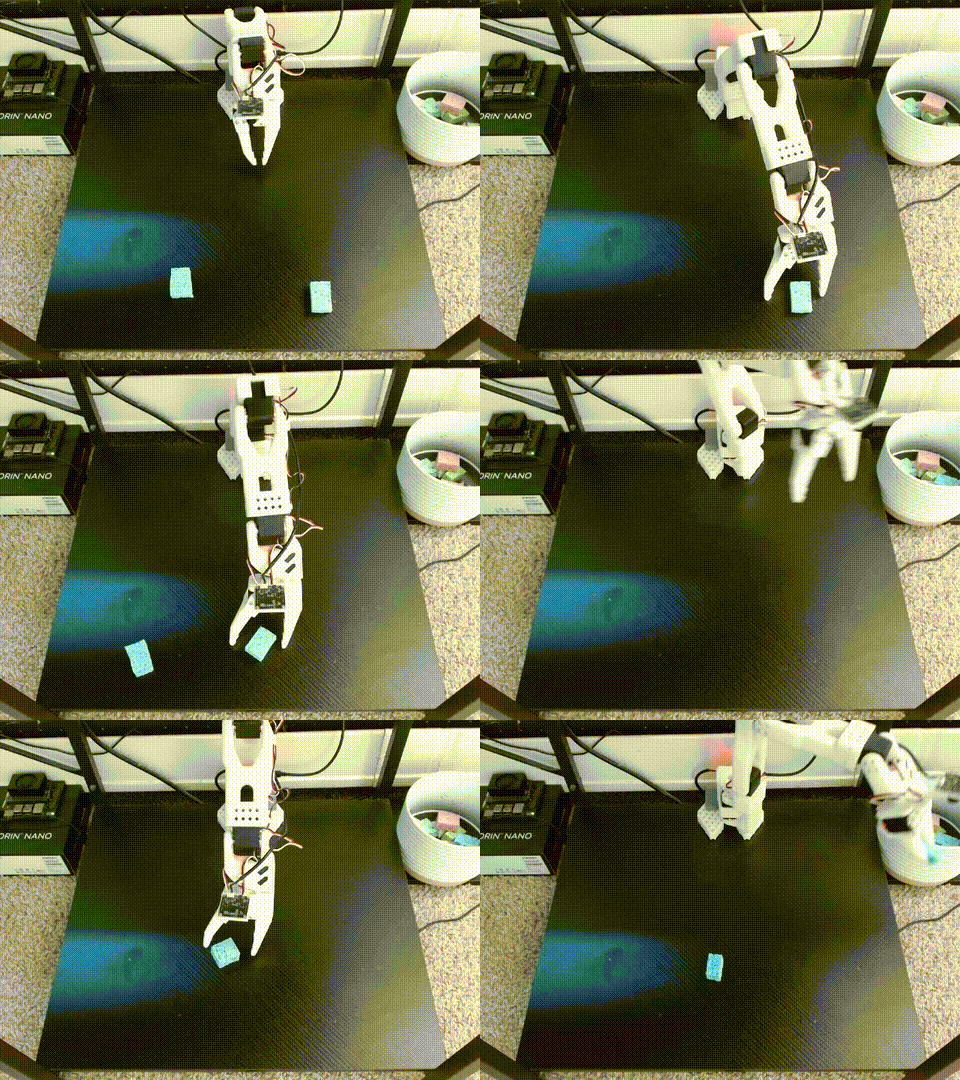
Task 1 teleop demo (D2)
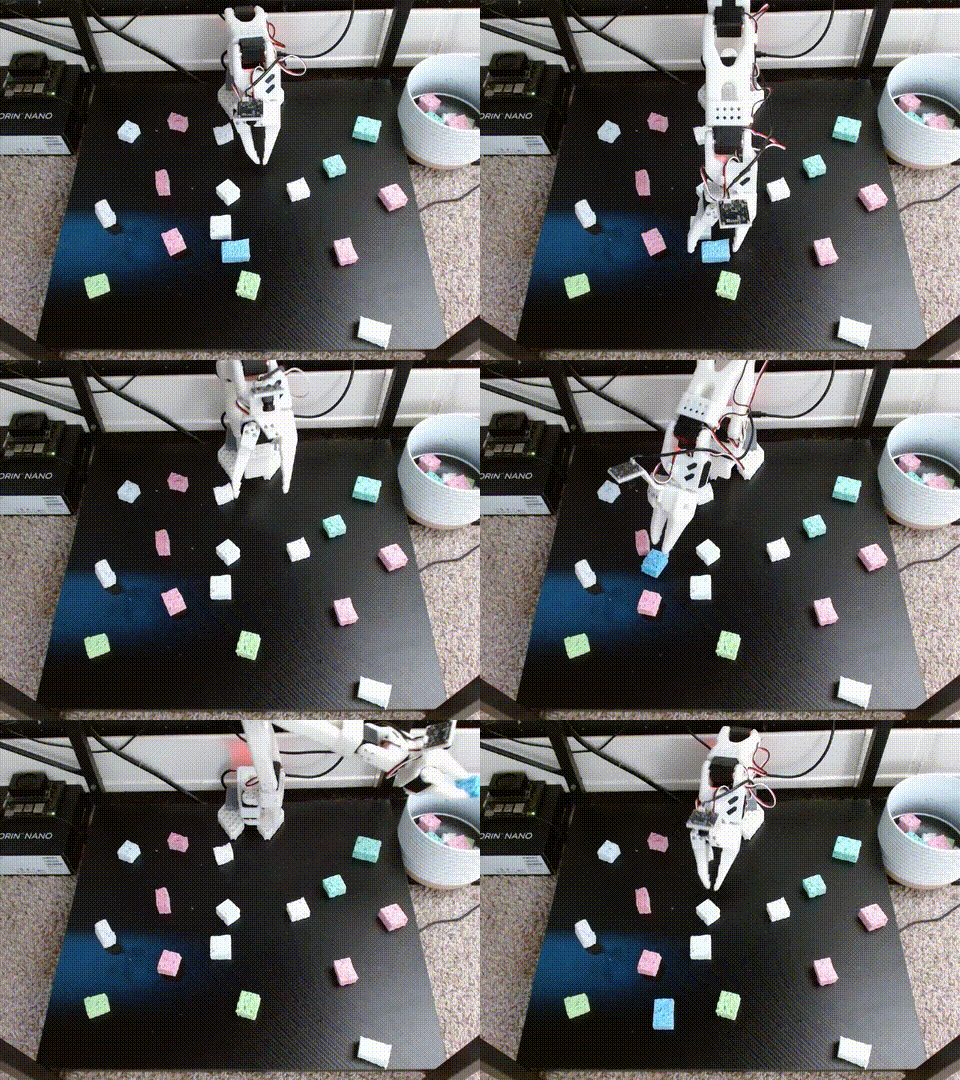
Task 2 teleop demo (D3)
From Teleoperation to 16 Dataset Recipes
384
episodes collected
5.7 hours
total collection time
2.51 h video + 30 s/episode reset
128 episodes × 3 tasks (T1, T2, T3)
128 episodes × 3 tasks (T1, T2, T3)
🤗 HF
Open dataset:
huggingface.co/datasets/aswinkumar99/LeRobot-SO101-Pick-Place
— Page 1, Trending LeRobot tag
| K | R | Mixed | Combined | Cross-task | |
|---|---|---|---|---|---|
| T1 | D1-K | D1-R | D1-Mixed | D1-Combined | D_Universal · D_D2D3 D_D1D2-Half · D_D1D3-Half |
| T2 | D2-K | D2-R | D2-Mixed | D2-Combined | |
| T3 | D3-K | D3-R | D3-Mixed | D3-Combined |
Total: 16 datasets
Four Architectures, Four Design Philosophies
ACT
~84 M params
Transformer encoder–decoder + CVAE
Properties
- Action Chunking Transformer (Zhao et al., ALOHA)
- Trained from scratch, no visual or language priors
- Predicts a chunk of future actions per observation
Recipe
--policy.type=act· 60 000 steps · batch 32- Cameras: overhead + wrist
Prediction: should plateau without data scale.
SmolVLA
~450 M params
SmolVLM-2 (256 M) + action expert (~200 M)
Properties
- Hugging Face open VLA (2025)
- Pretrained on community LeRobot datasets
- VLM backbone gives language + visual grounding
Recipe
--policy.path=lerobot/smolvla_base· 20 000 steps- Full fine-tune on each dataset
Prediction: should benefit from limited data via VLM grounding.
Pi0.5
~3.4 B params
PaliGemma (3 B) + flow-matching action head
Properties
- Physical Intelligence π₀.₅ (2025)
- Trained across many robot embodiments
- High-level VLA reasoning + low-level action expert
Recipe
--policy.path=lerobot/pi05_base· BF16 · H200- Action expert only, vision encoder frozen · 20 000 steps
Prediction: robust priors but higher inference cost.
Opus 5.5
0 robot demos
Claude Code agent + so101 MCP server (28 tools)
Properties
- Anthropic’s general-purpose model, never trained on this robot
- Sees the cameras through tool calls (look, detect)
- Plans, acts, checks and retries; writes its own skills
Setup
- Headless
claude -p· effort high · robot tools only - Same one-line instruction as the IL policies
Prediction: should handle new layouts and setups, but slower and with a cost per run.
DiT excluded after pre-flight (failed in-distribution evaluation). Parameter counts are approximate; Opus’s size is not published.
Training Structure — 202 GPU-hours on Cloud Infrastructure
202
total GPU-hours
Per-model averages: ACT ≈ 3 h × 16 = 48 h · SmolVLA ≈ 4.5 h × 16 = 72 h · Pi0.5 ≈ 6.6 h × 7 = 46 h · DiT ≈ 9 h × 4 = 36 h.
ACT
SmolVLA
6 × RTX PRO 6000 Blackwell
parallel training pool
Wall-clock
26 h
×
GPUs
6
=
GPU-hours
156 h
- • 32 models — ACT × 16 (~3 h each) + SmolVLA × 16 (~4.5 h each)
- • Docker image:
huggingface/lerobot-gpu - • Launched via
train_matrix.sh all&train_combo_matrix.sh - • ACT: 60 K steps / SmolVLA: 20 K steps
Pi0.5
NVIDIA H200
single-GPU run for the 3.4 B-param model
Wall-clock
46 h
=
GPU-hours
46 h
- • 7 models (3 base ×
-all+ 4 combo) - •
--policy.dtype=bfloat16· batch size 32 - •
train_expert_only=true, vision encoder frozen - • 20 K steps · 1 K-step warmup · LR 5e-5
Inference
RTX 4090 Mobile
on-robot laptop
ACT
30 Hz
SmolVLA
~30 Hz
Pi0.5
~6 Hz
Only Pi0.5 is much slower (~6 Hz), which matters for its time-to-success results.
DiT × 4 attempted but excluded after pre-flight (zero in-distribution success). All other 39 models converged.
How Claude Drives the Arm: MCP Tools + Project Memory
Claude Code · Opus 5.5
headless on a laptop · effort high · robot tools only
Gets the one-line task, loads its project memory, then plans, acts and checks one tool call at a time.
MCP over HTTP · 28 tools · camera images come back as tool results
so101d MCP server
NVIDIA Jetson next to the arm
- See
- look · detect · survey · overhead_to_table
- Move
- move_to · move_by · set_gripper · go_to_pose · stop
- Batch with checks
- run_sequence · run_skill, stopping at the first failed check
- Remember
- set_project · project_values · project_notes · project_book · save_skill
- Calibrate
- calibrate_overhead · calibrate_table · camera_setup
50 Hz joint control · stops when a move is blocked
SO-101 arm
Overhead camera
Wrist camera
Project memory
Stored on the Jetson, per project. Every run starts by loading it and ends by adding to it. Run 1 started empty; after 21 runs it held:
Skills7 saved
Multi-step recipes with built-in checks, e.g.
pick_sponge_to_bowl: hover, align on the wrist image, descend, close, check the grip load, lift, carry, release.Values9 keys
Facts it measured, e.g.
bowl_drop, the release point above the bowl, and max_direct_grasp_x = 33 cm.Project book4 questions
Questions answered by experiment, with evidence and a re-check step, e.g. “Which ‘blue’ detections are really aqua decoys?”
Notes22 entries
One entry per run: what worked, what failed, what to try next.
load memory→look & detect→run skills with checks→save lessons
Results: 20/20 on Both Tasks, With Zero Demos
| System | Training | Score /20 | Median time | API cost per run | Decision speed | ||
|---|---|---|---|---|---|---|---|
| Task 1 | Task 2 | Task 1 | Task 2 | ||||
| ACT | 384 demostrained from scratch | 19.0 | 15.5 | 112.0 s | 29.0 s | ≈ $0* | ~30 Hzaction chunks |
| SmolVLA | 384 demosfine-tuned | 20.0 | 5.0 | 64.5 s | 38.5 s | ≈ $0* | ~30 Hz |
| Pi0.5 | 384 demosfine-tuned | 20.0 | 13.0 | 113.5 s | 48.5 s | ≈ $0* | ~6 Hz |
| Opus 5.5 + MCP | 0 demosno training | 20.0 | 20.0 | 123 s | 95 s | $0.56 · $0.46Task 1 · Task 2, list price | 3.5 s per LLM call~12 calls per run; the arm moves at 50 Hz |
21 / 21
runs succeeded, including the robustness run
$10.62
API cost for all 21 runs, $0.25 per sponge placed
2–3× slower
than the IL policies on Task 2; on Task 1, about as fast as ACT and Pi0.5
* IL inference costs ≈ $0 per run; the real cost was one-time: 384 teleop demos (5.7 h) and 202 GPU-hours. IL rows: April 2026 eval, 16 trials per task, another bowl and camera position, policies on an RTX 4090 laptop GPU. Opus Task 1 scenes had 1–6 sponges (IL: 2). Times are medians over successful runs.
It Gets Faster by Writing Down What It Learns
134 s → 52 s per sponge
Task 1, cold start vs the median of runs 7–10: 2.6× faster.
$0.35 → $0.15 per sponge
API cost over the same runs.
Slow run → new skill
Run 6 took 103 s per sponge and saved 2 skills; run 7 took 50 s. Run 14: 281 s → 85 s. Run 16: 574 s → 82 s.
670 s → 123 s
First Task 1 run vs first Task 2 run: the new task reused Task 1’s calibration and skills instead of starting cold.
a skill was saved in that run
Seven Skills Claude Wrote for Itself
SkillSavedWhat it does, and why it exists
pick_sponge_to_bowlrun 1First full recipe: hover, align on the wrist image, descend, close, check the grip load, lift, carry, release.
drag_sponge_closerrun 1Sponge out of reach (beyond 33 cm): put the closed gripper behind it and pull it 9 cm back.
hover_low_lookrun 6After missed grasps: hover 4 cm above the sponge and return the wrist image to fine-tune the aim.
grasp_lift_to_bowlrun 6Go down to ~1 cm (2 cm slipped), close, check load ≥ 8 %, lift, carry, release.
grasp_slow_carry_to_bowlrun 14A soft grip slipped at normal speed: the same grasp, then a slow lift and carry.
grasp_lift_lookrun 16After two drops: grasp, lift 3 cm and check the wrist image before carrying.
carry_to_bowlrun 16Slow carry to the saved drop point, then release.
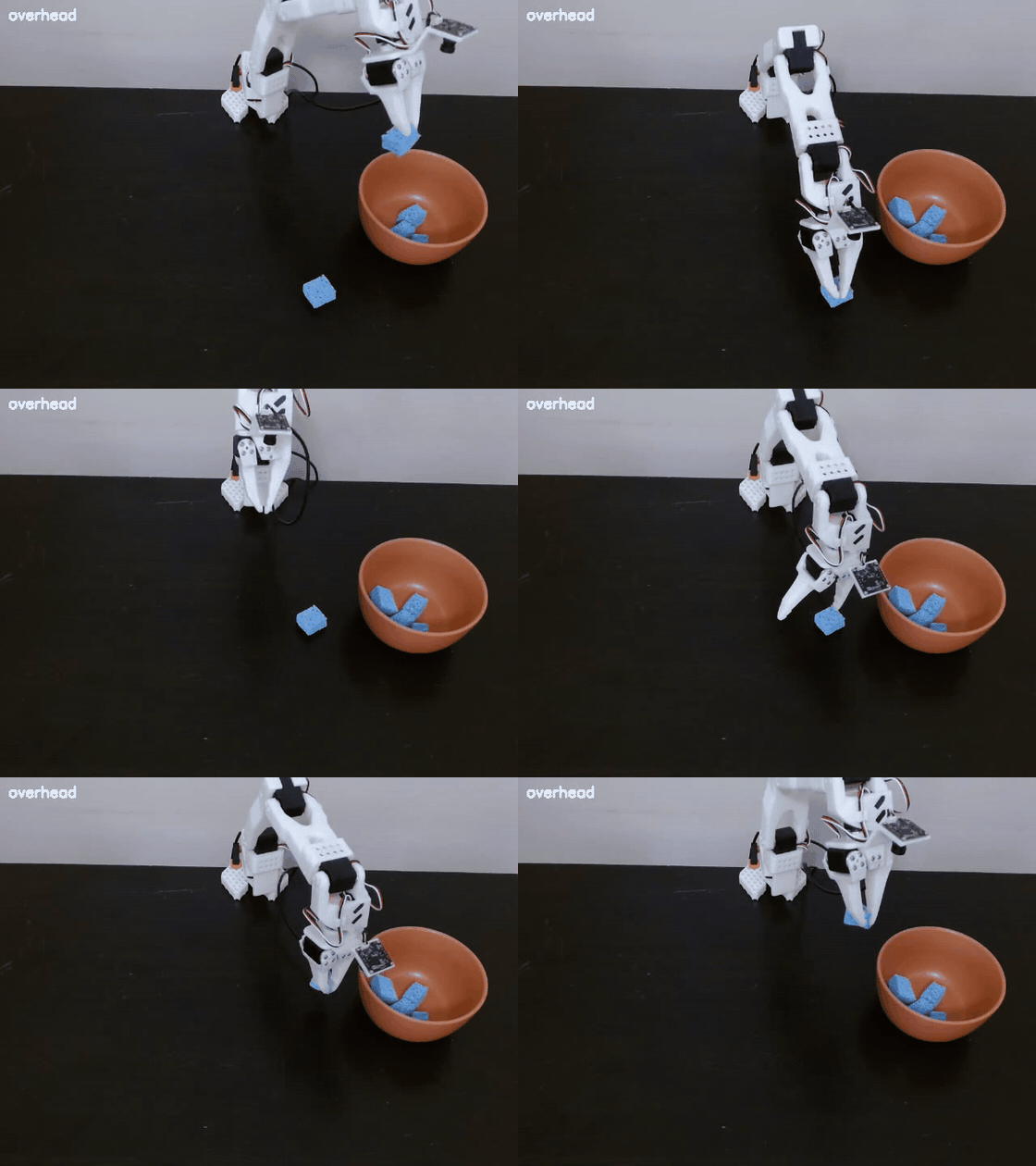 4× speed
Task 1, run 9: the last sponge sits at 35 cm, out of reach. Claude runs drag_sponge_closer, then picks it with the grasp skills.
# saved in run 1, used whenever x > 33 cm
drag_sponge_closer(x, y)
  set_gripper 0             # close the jaws
  travel      x, y, z=10
  move_by     dx=+1.5 dz=-6.5  # just beyond it
  move_by     dz=-2.7       # down to the table
  move_by     dx=-9 speed=0.2  # pull 9 cm closer
  move_by     dz=+6         # lift, then re-detect
How Flexible Is It? Light, Bowl and Bowl Position Changed at Once
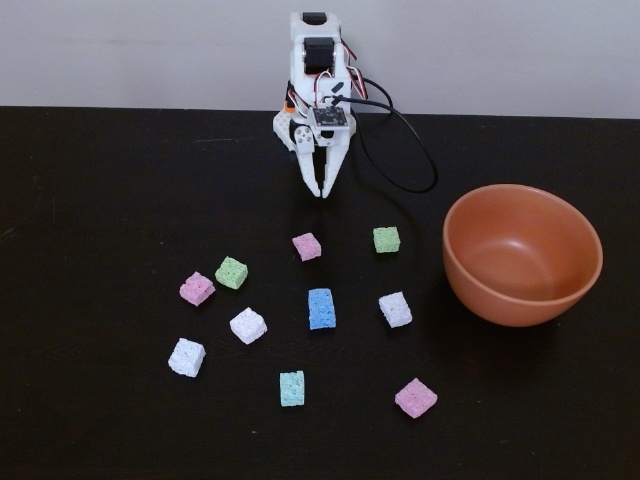
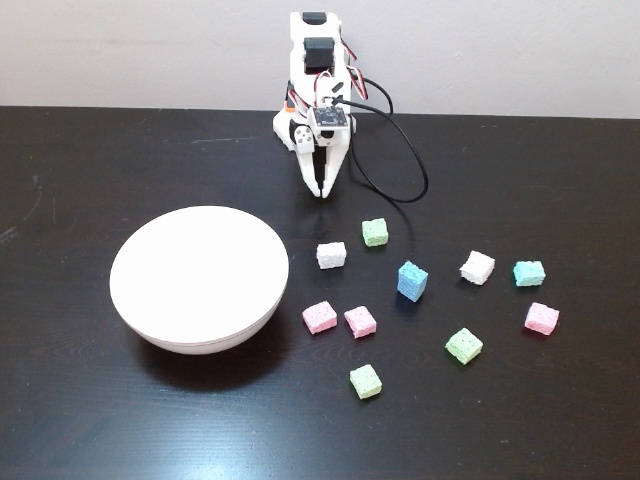
Lightingchanged
Bowlnever seen before
Bowl positionother side of the arm
“The saved drop point was for the old orange bowl at (24, 16), so I didn’t use it. I checked the new bowl with the wrist camera before letting go.”Claude’s report after the run. Nobody told it what had changed.
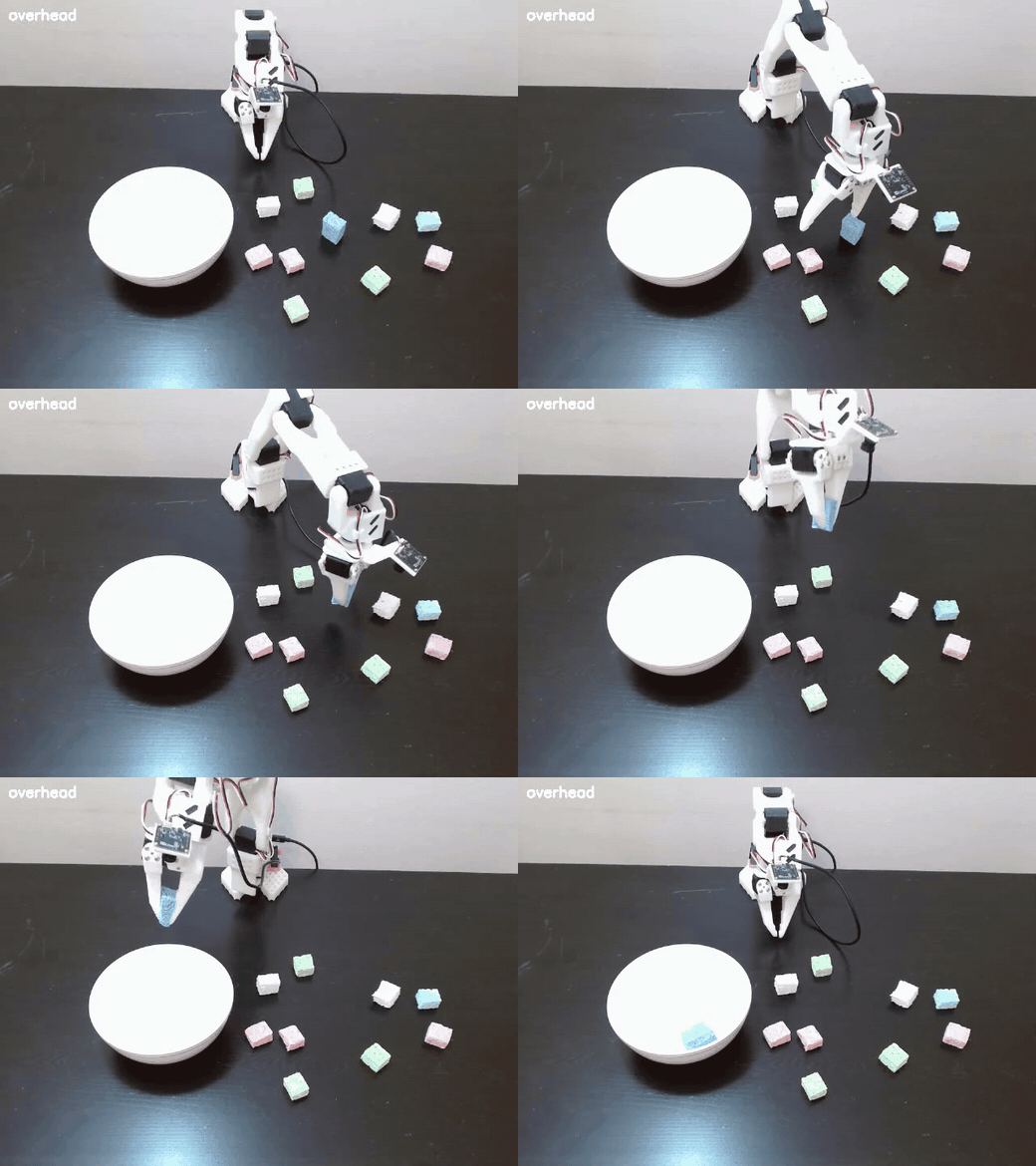 4× speed
✓ success, first grasp124 s14 LLM calls$0.470 new demos
Afterwards it saved the new bowl position and drop point, so later runs start from the new setup. The IL policies only ever saw one bowl, in one spot, under one lighting setup.
Everything Is Open
Project page
aswinkumar.me/so-arm101
GitHub
aswinkumar1999/so-arm101-imitation-learning
Hugging Face dataset
aswinkumar99/LeRobot-SO101-Pick-Place
Eval gallery clips
aswinkumar99/so101-eval-gallery
The study, the 384 demos and every IL rollout, open on GitHub and Hugging Face.